
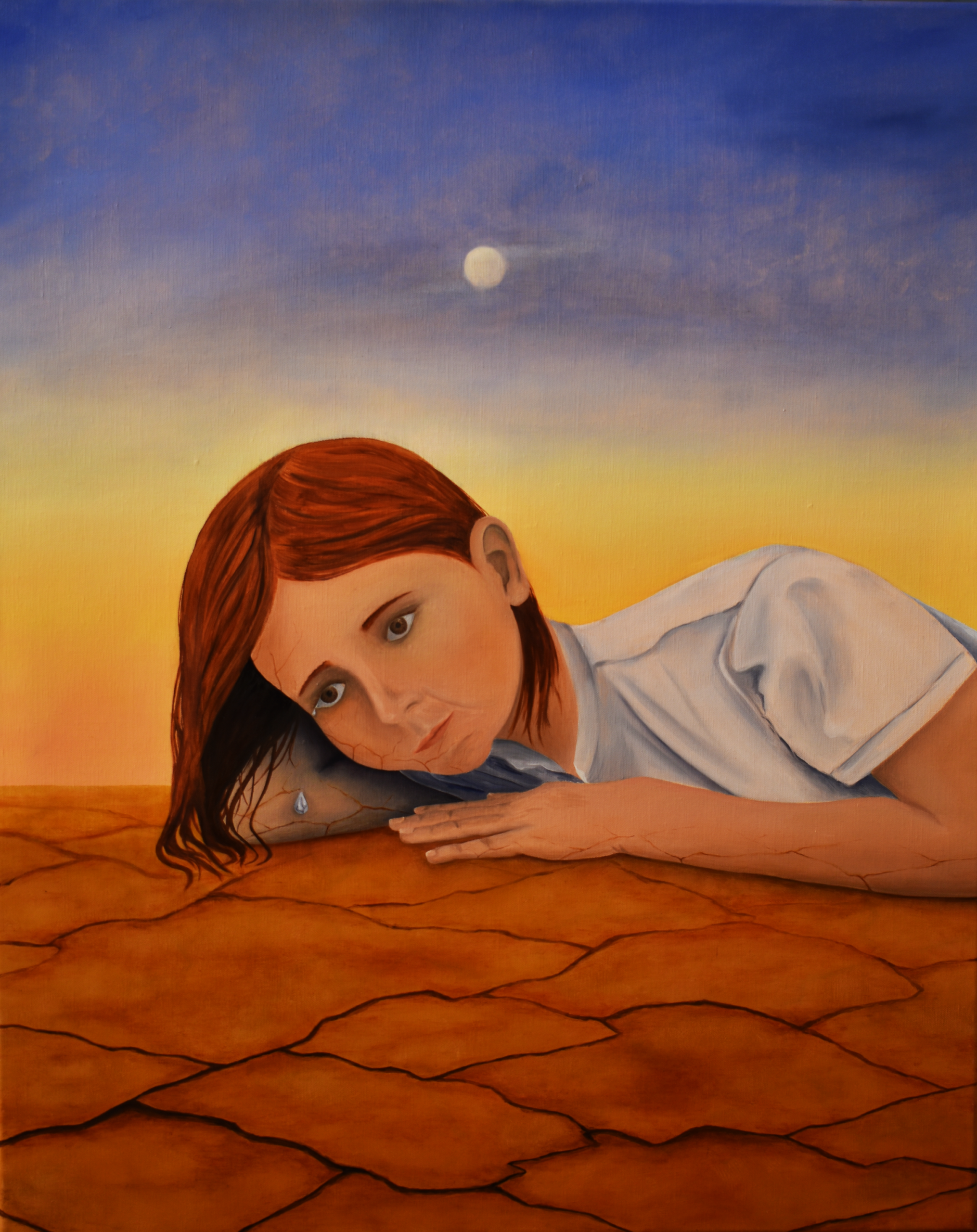
This work interrogates the unstable boundary between identity and environment, presenting a figure whose self is no longer defined as an autonomous entity, but as a porous construction shaped by its surroundings.
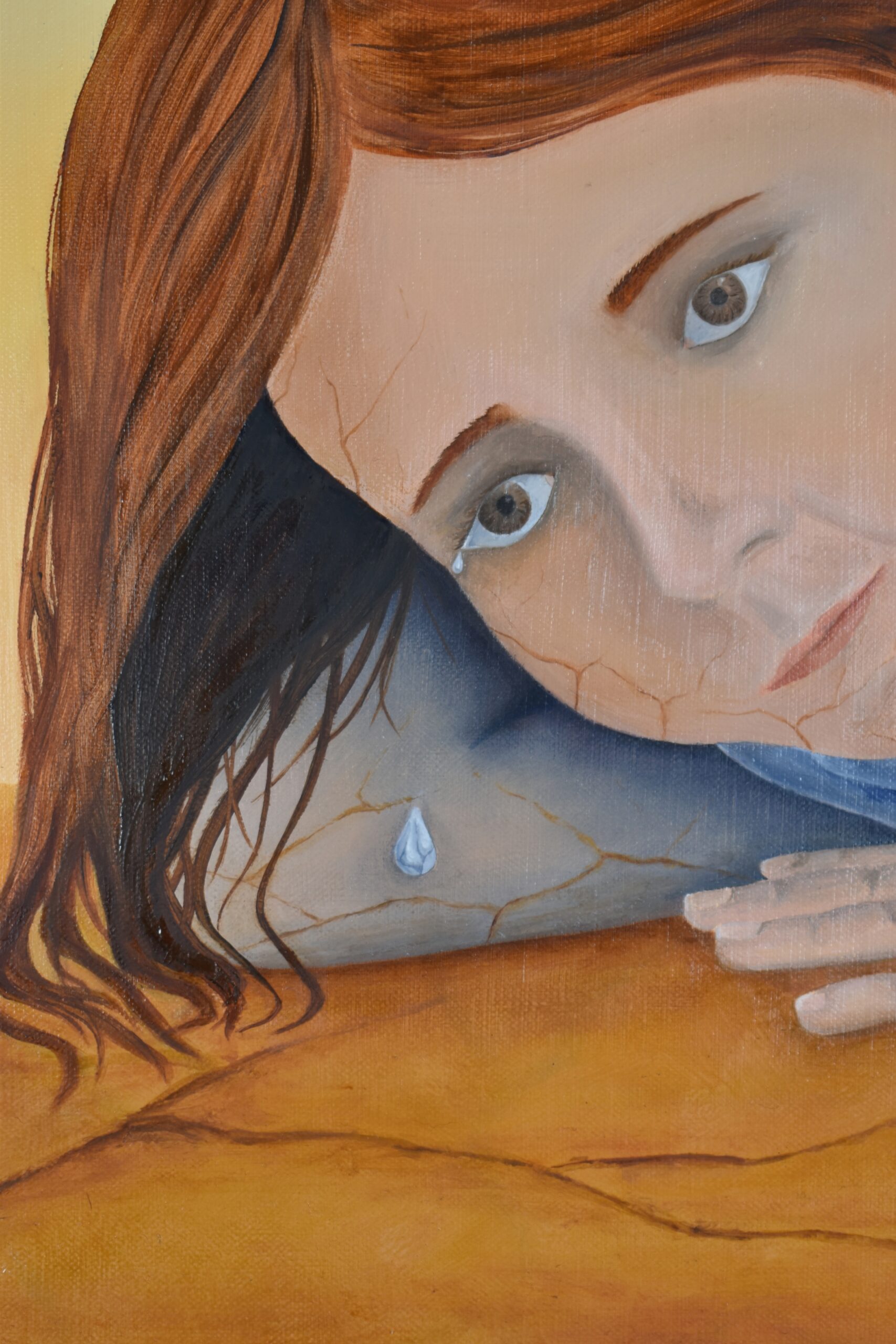
The young girl does not stand before the world: she gradually merges into it. Her skin adopts the texture of cracked earth, blurring the distinction between body and landscape. This fusion raises a fundamental question: does what I feel of the world become my identity, or is it merely an unstable projection of what surrounds me?
Identity appears here not as a fixed essence, but as a process of continuous transformation, subject to perceptions, affects, and external conditions. The self becomes a surface of inscription, constantly rewritten by the real.
In this logic, the boundary between interior and exterior dissolves: the environment is no longer a backdrop, but an extension of the psyche. Landscape and body respond to one another, until they become inseparable.
The tear, suspended without falling, acts as a point of rupture within this fusion. It is neither entirely matter nor entirely emotion: it embodies a state of suspension, a hesitation between presence and dissolution. It becomes the sole sign of an interiority still perceptible, yet already traversed by the external world.
Thus, the work offers a vision of identity as a fragile illusion — not a stable truth, but an unstable equilibrium between self-perception and the projection of the world.