
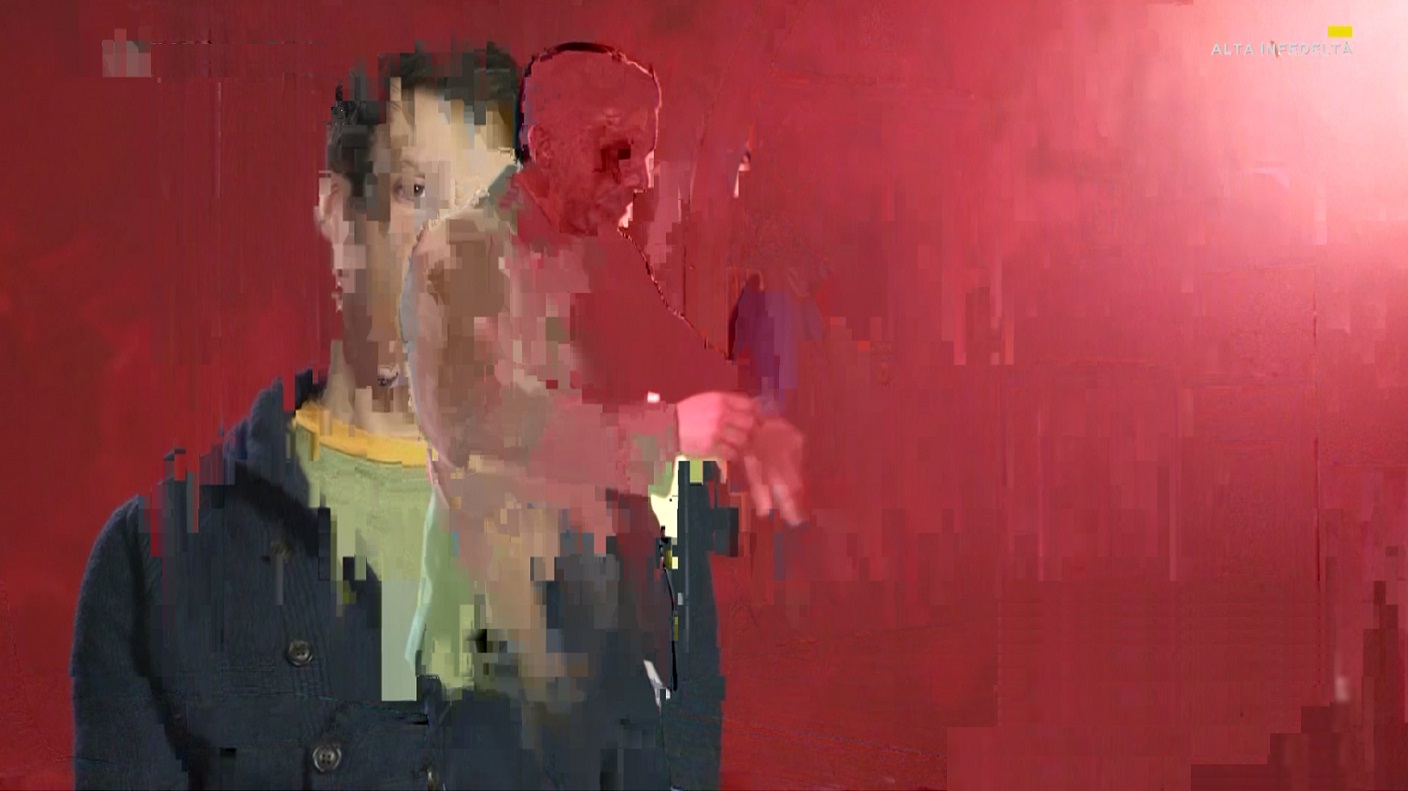
Analogue Illusionism
Year2024
MediumDigital Artwork on Canvas
Dimensions 160 × 90 × 3 cm
Price€6300 EUR
The work Analogue Illusionism represents a true deconstruction of visual identity, where the "snapshot" is no longer a static snapshot, but the frame of an ongoing process: • The image ceases to be a frozen instant and becomes a compressed time sequence. The subject is not captured in a single pose, but "spread" through a duplication of the emotional and physical states that overlap, suggesting a movement that spans time. • The reference to Francis Bacon is fitting and profound. As in Bacon's canvases, where the figure is deformed to reveal an inner truth that is more raw than mere physical appearance, here technology (the glitch, the decomposition) acts as an expressionist brush. • The choice employed is not limited to a simple aesthetic effect, but leads to a disruption of the figure's coherence. The decomposition of the subject into chromatic and structural fragments—visible both in the distortion and in the chromatic explosion of an incandescent, oblique purple light—transforms the meaning of the image into an unstable signal, reflecting a psychological unease that is the very foundation of modern expressionism. • The apparition represents a stark contrast between the "flesh" (the humanity of the subject and its projection) and the "code" (the digital glitch). This friction creates a narrative of "infidelity"—not only thematic, but technical—where the image betrays its very realistic nature to reveal a fragmented and unstable reality. The work could be defined as a form of digital expressionism in that the glitch does not represent an error, but a true language that allows for the representation of the complexity and vulnerability of identity in transformation, a theme already encountered in Donka's Self-Portrait Card Format.