
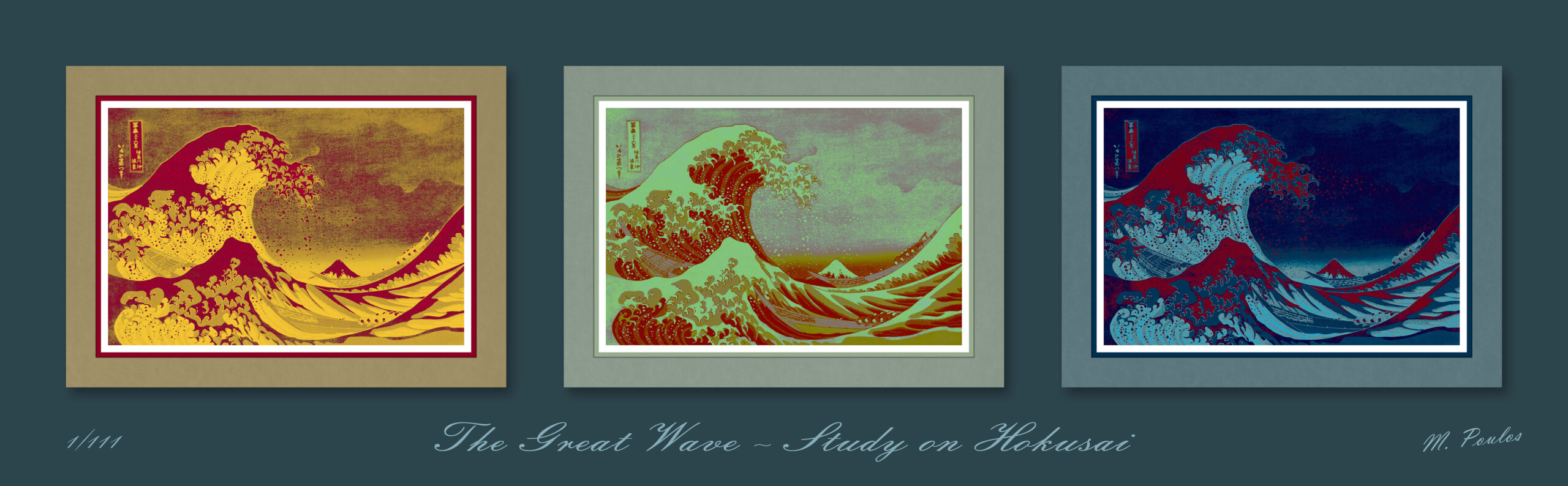
The Great Wave ~ Study on Hokusai
Year2025
MediumPhotograph on Dibond
Dimensions 244 × 76 cm
Price€3500 EUR
Hokusai’s The Great Wave is perhaps the Japanese artist’s most iconic painting and arguably his most recognizable work in the West.
Like any iconic masterpiece, The Great Wave embodies within its form a self-similarity, which unfolds through a paradoxical correlation between the differences and similarities of its constituent elements.
This paradox arises precisely from its holographic and fractal structure, in the sense that every element within the pictorial space emerges from, and simultaneously influences, every other element.
In Hokusai’s painting, a dynamic, fractal structure emerges between the transient fluid form of the wave and the solid presence of Mount Fuji in the background; between the boats that replicate the curve of the waves while simultaneously being threatened by them; between the stillness of the figures aboard the boats and the fluidity in the splashes of the frothing waves.
It is a pictorial structure that reveals the paradox of complexity as simplicity, and simplicity as complexity. A structure, ultimately, akin to an unsolved equation undergoing iterations on the boundary between order and chaos.
This dynamic form within this particular painting made me realize an additional paradox: that authentic time is defined not by motion, but by stillness.
It is a paradox that allows a sensitive observer to perceive time as it unfolds in small pockets of immobility, just as it does in The Great Wave by the Japanese artist Katsushika Hokusai.