
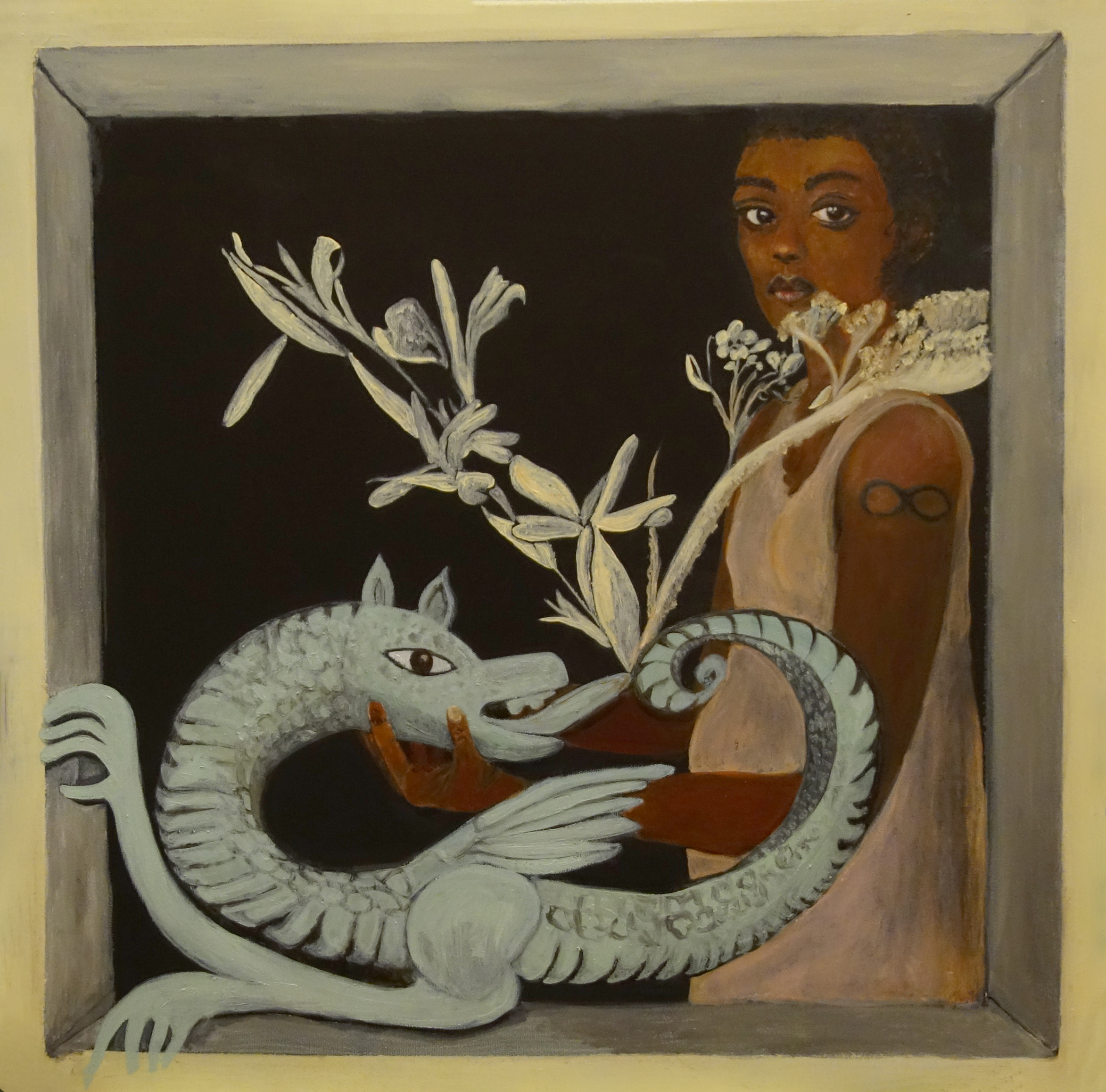
Limonium catanense / Tra Ouroboros e fiore / LICASI
Year2025
MediumOil on Canvas
Dimensions 60 × 60 × 5 cm
Price€2500 EUR
This work presents two views of a Limonium plant, also known as sea lavender, within a figurative space that functions as a frame of memory. The plant appears twice: as a fragile botanical study and as its own reflection, suggesting the coexistence of two temporal layers. It is rendered in Naples yellow, the color it assumes in the absence of chlorophyll, thus evoking loss, transformation, and altered vitality.
Beneath it appears an Ouroboros, the ancient serpent symbolizing the cycle of life and death. Borrowed from the wall of Ptuj Castle, it departs here from classical iconography: instead of biting its own tail, it licks it. At this precise point of contact, the Limonium begins to sprout—a delicate emergence of life that does not close the circle, but transforms it into movement and continuation.
On the right stands a pregnant Black woman with short hair, whose gaze meets that of the viewer. She wears a transparent pink dress and bears the infinity symbol on her bare left arm. With bent arms, she gently supports the face of the Ouroboros. Her pregnancy links the myth of eternal recurrence with the embodied experience of life about to emerge, turning infinity into transmission.
Rare in Italy, Limonium symbolizes constancy, memory, gratitude, and resilience. Because it retains its form even when dried, it points to endurance and the ability to survive difficult conditions. Its growth at the moment of the serpent’s touch reinforces this reading: from contact, something new arises; permanence becomes continuation.
The work thus presents the Ouroboros not as a closed circle, but as an open process of transformation and rebirth. Between plant, serpent, and human figure, a poetic space unfolds that reflects on transience and duration, memory and transmission, and a form of infinite life that does not close in on itself, but continues to grow.