

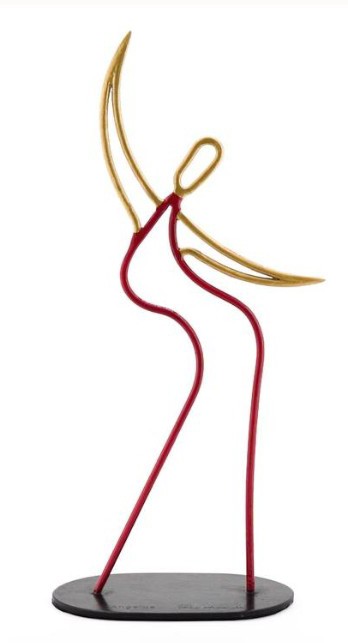
Italy, 1964
Born in Rome on July 7, 1964, Mancini grew up watching his father (Mancini Domenico), a mechanic enthusiast, make small crafts using everyday materials. Mancini first came into contact with the world of sculpture in his hometown of Rome. From an early age, he visited the Vatican Museums and admired Roman and Greek sculptures.
At the age of 15, he helped a friend in his friend's father's ironworks in Rome. After graduating from the Technical Design and Surveyor School, Mancini Art attended sculpture classes at the Italian Academy in Perugia and ceramics courses in Rome. This allowed Mancini Art to learn new techniques and deepen his interest in art. He then traveled to several countries. As a young man, he visited New York, Hong Kong and Singapore, where he admired and studied skyscrapers. This experience was crucial for his later architectural career in Australia.
In Sydney, Australia , he worked for several established architects, including Dino Burattini, Robertson & Marks and Fuller Cook, as well as proposing new projects and preparing architectural models.
During his early life in Japan, Mancini Art also worked on furniture design. This included chairs, tables, and wall clocks. He was initially encouraged to design his own furniture, but later sold them privately. This furniture was made using wood from Hokkaido. While in Japan, he worked with architects from Hokkaido. These experiences would form the basis of his later work. [ 2 ]
Since 2020 he has been regularly exhibiting in group exhibitions in Italy and Japan. He has found various bronze foundries in Northern Italy to create his sculptures.
In 2025, he was an auditor for marble and hard stone technology at the Academy of Fine Arts of Frosinone, Italy.
From May 23 to 25, 2025, he held a solo exhibition entitled "Neo-minimalista" at the Sala Comunali Ruspoli in Cerveteri, near Rome, in which he presented a series of sculptures inspired primarily by bonsai . Visitors were invited to admire his sculptural reinterpretations of the delicacy and splendor of small trees, and the exhibition was open to the public free of charge.
In 2021 he won a Gold Art Award in Tokyo Metropolitan Art Museum.